
Guide · Financing & terms
Modernisation loan: the land charge decides, not the rate.
Five of the ten most-read pages on this topic belong to banks. None of them can tell you which product is the right one.
As at 15 September 2026 · approx. 10 min read · Enrico Li Fonti
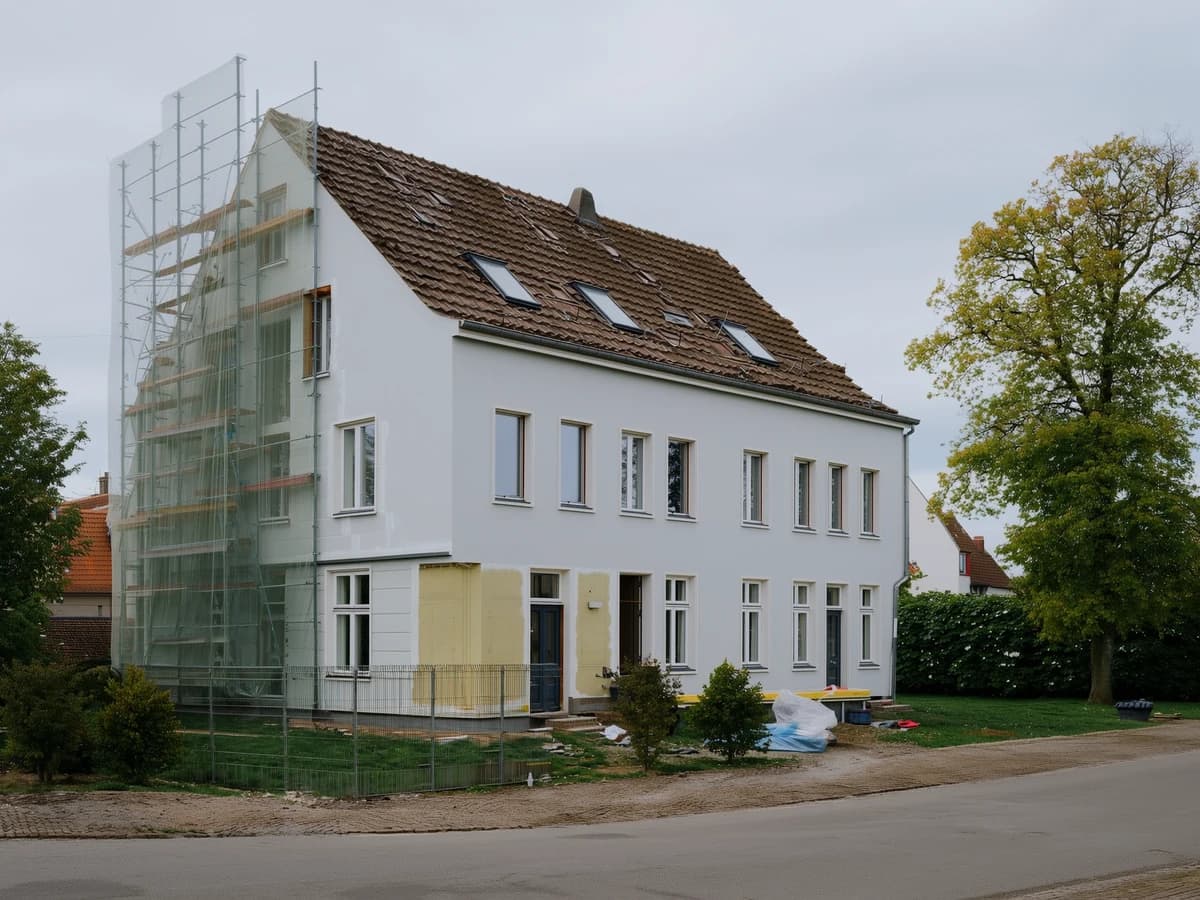
Symbolic image created with AI. It does not depict real people, properties or events.
Most people compare interest rates. The more expensive decision is made earlier, in the land register.
A German modernisation loan finances work on an existing property, meaning heating, windows, insulation, a bathroom or electrics, without setting up a full mortgage. It sits between an unsecured consumer loan and a property loan. The real decision is not made over the interest rate but over the land register. If the loan is secured by a land charge the rate falls considerably, but notary and land registry fees arise and the process takes longer. Those fees are fixed by the GNotKG and based on the nominal amount of the land charge, not on the loan. Without a registration the money arrives faster, as long as the sum stays small. Whether the security pays for itself depends on the amount, the term and on whether a land charge is already registered. For let properties, § 559 BGB is added.
One note on scope. If you are still buying a property and want to finance the modernisation alongside it, that is not modernisation financing but a mortgage with an increased requirement. If your fixed-rate period is ending and you want to modernise at the same time, the topic belongs to follow-on financing. This guide covers the case in between: the property is yours, the existing financing is running or repaid, and money is needed for work on the building.
What counts as a modernisation loan
The term is not a legal one, it is a product name used by banks. It means a loan for work on a property that already belongs to the borrower. In German price lists you will find the same product as Modernisierungsdarlehen, Renovierungskredit or, at the savings banks, as S-Modernisierungskredit.
Typical uses are replacing the heating system, new windows, insulating the roof and facade, a new bathroom, rewiring, age-appropriate conversion, and extensions. The range therefore runs from a single measure to a full energy refurbishment of the house.
Two features distinguish it from its neighbours. Against an unsecured consumer loan the purpose is fixed, which lowers the rate. Against a classic mortgage the land charge is not mandatory, which speeds the process up. That middle position is the whole point of the product.
This middle position also has a practical floor and ceiling. For very small amounts covering purely cosmetic work, the effort of a purpose-bound assessment outweighs the interest saved, and an unsecured consumer loan is the more honest route. For very large projects that take on the character of a full gut refurbishment and run over years, modernisation financing effectively becomes a mortgage again, with a correspondingly longer fixed-rate period and staged drawdowns. In between lies the field this product was made for.
Modernisation, renovation and refurbishment kept apart
In everyday German the three terms are used interchangeably. Under the funding rules they are not. Using the wrong one means applying for the wrong programme.
- Renovierung (renovation). Cosmetic work without touching the fabric: painting, wallpapering, floor coverings. Not eligible for energy funding, and for a lender a case for a consumer loan.
- Modernisierung (modernisation). Raising the standard above the previous condition: a new heating system, better windows, insulation, age-appropriate conversion. This is the eligible core.
- Sanierung (refurbishment). Remedying damage and defects, for example damp or failing structure. Can be eligible where the energy standard rises at the same time.
In practice that means a new bathroom on its own is renovation, whereas a level-access bathroom with an age-appropriate layout is modernisation. For the financing this matters, because only the second version opens access to public funding.
The land register threshold
This is where the decision is made, and this is where bank product pages fall silent. A modernisation loan can be granted with or without a land charge. Both have a price, they simply fall due at different times.
With a land charge the lender gains security over the property. The rate falls considerably, the possible sums rise and terms get longer. In return, notary and land registry fees arise once, and several weeks pass between application and disbursement because a notary appointment and the registration sit in between.
Without a land charge those costs and that waiting time disappear. The lender carries a higher risk and charges a higher rate. Sums are capped and terms are shorter.
The cost of registration is not a matter of negotiation. It follows from the German Court and Notary Fees Act and is based on the nominal amount of the land charge. Not on the purchase price, not on the loan amount. That is precisely what makes the threshold calculable: on one side stand one-off fees fixed by statute, on the other an interest saving that accumulates over the full term.
Three factors move the threshold
Three factors move that threshold. First the amount: the larger the sum, the more the interest saving outweighs the fixed fees. Second the term: over twenty years a rate difference bites far harder than over five. Third, and this is most often overlooked, an existing land charge. If a charge is still registered on your property and repayment means it is no longer fully drawn, the freed-up portion can often be reused without a new registration. The most expensive item in the calculation then disappears.
As a sequence for your own assessment, this order has proved useful: first, is a land charge still registered and how much of it is still drawn. Second, how large is the financing need in relation to it. Third, over what period is it to be repaid. Only once those three points are settled does comparing interest rates make sense. Anyone working in the reverse order is comparing offers that do not share the same structure.
For the opposite direction, removing the charge once the loan is repaid, we have written a separate piece: deleting or keeping a land charge. How a lender values your property is covered in the guide to the mortgage lending value, and the cost of a notary appointment in the guide to notary fees when buying.
When proof of use is required
Proof of use is the second question that is barely answered online although it is asked constantly. The answer does not depend on the lender but on the type of credit.
- Purpose-bound modernisation loan. The lender wants to know what the money is spent on, because the lower rate hangs on exactly that. Written quotes before approval and contractor invoices after disbursement are the norm.
- Unsecured consumer loan. No proof, but a higher rate. The lender prices the premium precisely for not knowing the use.
- Subsidised loan and grant. Proof is always mandatory and tied to deadlines. For energy measures, confirmation by a certified energy efficiency expert is added.
The most important practical point concerns sequence. For funding programmes the application must be submitted and approved before the contract is awarded to the trade. Anyone who commissions first and applies afterwards loses the funding. That is the most common avoidable mistake in this entire field.
Six routes to modernisation financing
ME Finance covers the following six building blocks. They are sorted here not by product type but by the question that has to be settled first: does this need a land register entry or not.
- KfW residential building loan 261. For a full energy refurbishment to efficiency house standard. A low-interest loan with a repayment subsidy, funding up to 150,000 euros per residential unit. Applied for through your own bank, not directly with KfW.
- KfW grant 458 for heating. Since 2026 the heating subsidy is applied for as a grant with KfW rather than with BAFA. It can be combined with a loan for the remaining amount.
- BAFA grant for individual measures. Responsible for the building envelope, windows, ventilation and heating optimisation without a full boiler replacement. A grant, not a loan.
- Bausparen loan. Useful where an allocated contract is already in place. Rate certainty across the whole term, at the cost of flexibility.
- Modernisation loan without a land charge. The fast route for manageable amounts. No notary appointment, no registration, in return a higher rate and a shorter term.
- Topping up the existing financing. Often the cheapest route where a land charge is already registered and the same bank holds the running loan. The security is already in place.
In practice it is rarely one of these routes alone. An energy project frequently combines a grant with a loan, because the grant covers only part of the cost. That combination is exactly where a single bank reaches its limit: it can offer you its own product, but not which interplay is cheapest for your project. How we approach this is set out on the page for modernisation financing.
A note on currency: the former KfW programme 262 for individual measures was discontinued in 2022. Individual measures have since been funded through grants rather than a dedicated KfW loan. If you still see the number 262 on an older guide page, that page is out of date.
What drives the rate on existing property
A specific figure would be worthless here, because it shifts with the market. What is reliable is which factors move the rate, and in which order they act.
- Security. The strongest lever. The gap between secured and unsecured is wider than the gap between two lenders.
- Loan-to-value. The ratio of loan to mortgage lending value. The lower it is, the better the rate.
- Term and fixed-rate period. A longer fixed period means planning certainty but costs a premium.
- Credit standing. Income, employment status and SCHUFA record. What happens when this is the sticking point is covered in financing declined.
- Funding eligibility. A subsidised loan undercuts any market rate. That is why eligibility is checked at the start and not at the end.
One practical consequence follows from this ranking, and it contradicts the usual approach. Most people start with a rate comparison on a portal and settle security and eligibility afterwards. The reverse order makes more sense, because the two upper points shift the range further than any change of lender. An eligible, land-charge-secured project at a mid-priced bank beats an unsecured project at the cheapest provider on the comparison site.
Modernising a let property
For let properties one further question arises that does not apply to owner-occupied homes: part of the cost can be passed on to the rent, and that changes the calculation.
Under § 559 (1) of the German Civil Code a landlord may increase the annual rent by 8 per cent of the costs spent on the flat. The statute ties this expressly to modernisation measures, not to mere maintenance. The distinction from the second section of this guide therefore decides not only funding eligibility but also whether costs can be passed on.
For the financing this means part of the burden flows back through rental income. That pushes the land register threshold from the third section downwards, because a longer term becomes easier to carry. The tenancy law side, meaning notice periods, duties to tolerate work and hardship provisions, is a separate matter and belongs with a lawyer specialising in German tenancy law.
What to take from this guide
- The first question is not the rate but whether a land register entry is necessary and sensible.
- The cost of registration is fixed by the GNotKG and based on the nominal amount of the land charge. That makes the threshold calculable.
- A land charge that is already registered and no longer fully drawn is the cheapest starting point there is.
- Proof of use depends on the type of credit, not on the lender. It is the price of the lower rate.
- With public funding: apply first, commission second. The other way round the funding is lost.
ME Finance is not a credit institution and sells no product of its own. We compare the routes and work out the threshold for your project. If you would like to know which combination carries in your case, describe your project through the non-binding enquiry.
Frequently asked questions
- What is a Modernisierungskredit?
- A modernisation loan finances work on a property you already own: heating, windows, insulation, a bathroom, electrics or an extension. It sits between an unsecured consumer loan and a full mortgage. Unlike a consumer loan the purpose is fixed, which lowers the rate. Unlike a mortgage a land charge is not mandatory, which speeds the process up. That middle position is the entire point of the product.
- Which modernisation loan is the best one?
- The question cannot be answered in general, and for a structural reason: it depends on your project, the amount and on what is already registered in the land register. A single bank cannot answer it about its own product in any case. Three questions come first: how large is the amount, is a land charge still registered on the property, and is the measure eligible for public funding. Only then does comparing rates make sense.
- Is a modernisation loan possible without proof of use?
- That depends on the type of credit. A purpose-bound modernisation loan normally requires evidence of how the money was used, usually contractor invoices or written quotes. An unsecured consumer loan requires none, but carries a higher rate because the lender does not know what the money is for. For subsidised loans and grants, proof is always mandatory and tied to fixed deadlines. Proof is therefore not red tape, it is the price of the lower rate.
- How high are the interest rates on a modernisation loan?
- No reliable figure can be given, because it moves with the market and depends on your credit standing. What is reliable is the ranking: a loan secured by a land charge is considerably cheaper than an unsecured one, and a subsidised loan is cheaper than both. Term, loan-to-value and whether the measure qualifies for energy funding come on top. Anyone quoting a figure without knowing these points is quoting a headline rate.
- Is registering a land charge worth it for a modernisation loan?
- A land charge lowers the rate but costs notary and land registry fees once and delays disbursement. The calculation works out when the interest saved over the full term exceeds those one-off costs. It works out much faster if a land charge is already registered, because a charge that is no longer fully drawn can often be reused without a new registration. For smaller amounts over short terms, registration rarely pays for itself.
Your first consultation, free and without obligation.
30 to 60 minutes in which we listen to your situation, answer first questions and tell you transparently whether and how we can help. No sales pitch. No pressure.
- I.We get back to you within one working day by phone or e-mail.
- II.We arrange an appointment, in person, by phone or via video call.
- III.We assess your situation and tell you openly how we can support you.
Start your enquiry
A few quick steps to your personal assessment. Response within 24 hours, strictly confidential.
- Key facts about your plans and equity
- Occupation and net household income
- Preferred advisor, or leave it open
- Your contact details
Takes about 2 minutes. No credit check at this stage.